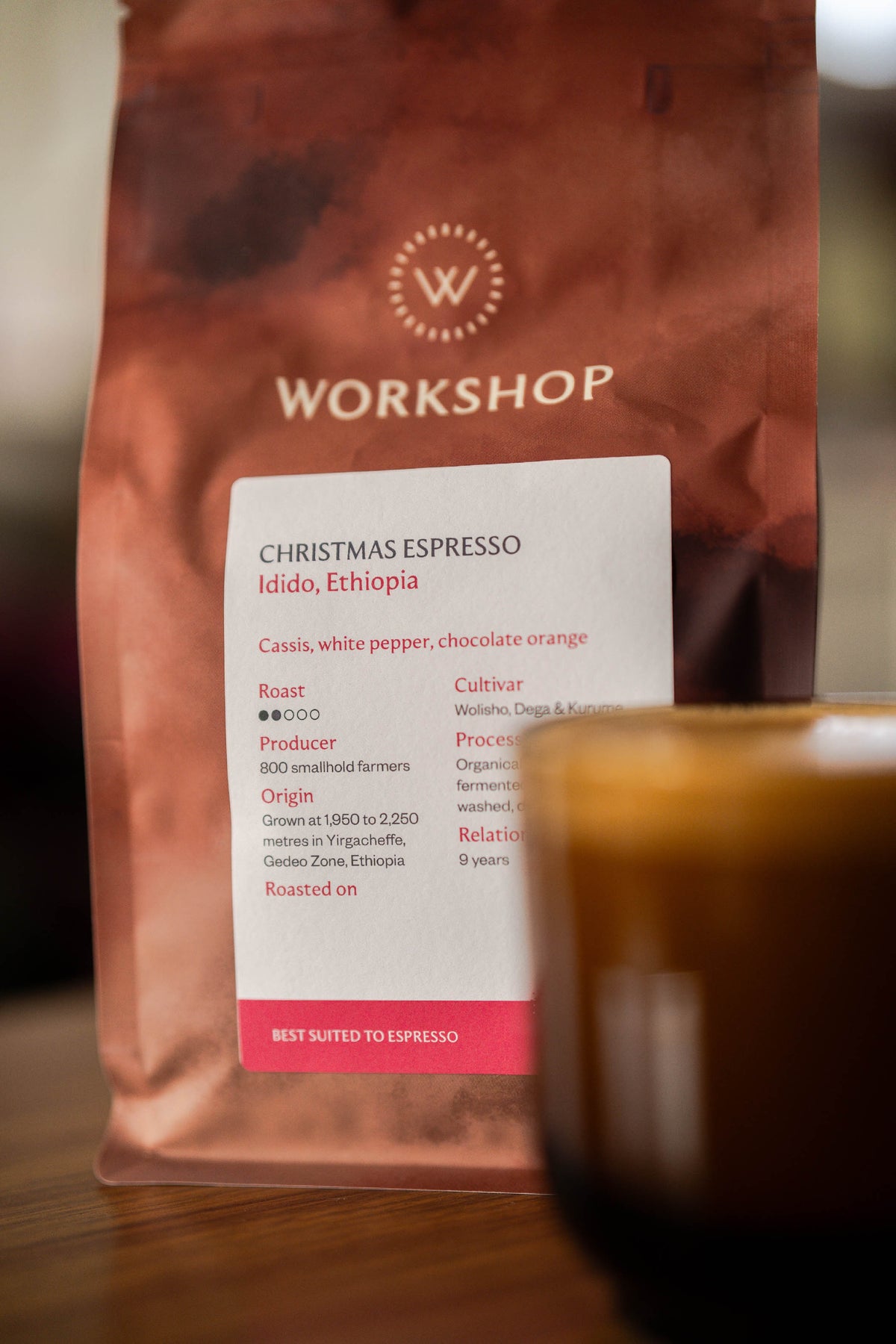
To enjoy throughout the colder months, we’re really loving the deep cassis-like fruit and chocolate orange warmth in this lovely espresso from Snap’s Ididio washing station in Ethiopia.
The Farmers
Around 800 smallholder coffee farmers close to Yirgacheffe town in Gedeo Zonehave contributed towards this lot. The cultivars are Wolisho, Dega & Kurume, which are tended to completely organically in a semi-forest system. Each farmer has between 0.5 and 2 hectares planted with coffee, amidst bananas and natural shade trees, with 1,500 to 2,400 coffee trees per hectare. Each tree only produces around 3kg of coffee fruit per season, which is delivered to the Idido washing station.
The Washing Station & Their Approach
Idido is owned and operated by Snap Coffee, from whom we buy other coffees such as Danche, Riripa, Refisa and Raro Boda. After depulping the received coffee cherries using an Agaarde disc pulper the coffee is fermented under cool water in ceramic tiled tanks for 72 hours, before washing and grading in long channels. The seeds are effectively graded by density in these channels and will be graded again once fully dried when the quality is refined at the dry mill using vibrating density sorting tables. It makes for a reliable product for us to roast, as the seeds are small and compact yet very dense, allowing an efficient transfer of heat through each seed and the entire batch.
The Exporter
Snap Coffee was established in 2008 by Negusse Debela Weldyes and the group are responsible for the running and operation of several coffee washing stations which feature in our coffee range each year. Snap oversee the processing facilities but also take on the task of dispensing agricultural knowledge to their contributing farmers. Their team of agronomists supports more than 6,000 smallhold farmers by dispensing training on crop husbandry and nursery management, as well as crop diversification and intercropping. Other steps such as tiling fermentation tanks to enable better cleaning, and implementing strict drying protocols, have gone long ways to improving the clarity, cleanliness and longevity of the coffees’ characteristics. They are committed to recycling waste by-products from coffee processing at each of their stations where they have also built schools and provided them with computing equipment from the other arm of their business which is in electronics. They have improved the roads to streamline access to the washing stations and have built health clinics to provide access to better healthcare for their contributing farmers as well. The lots of dried parchment are dry milled at Snap’s own processing and warehousing facility. This affords the group even more control and traceability over the final exportable product that we get to work with, leading to improved consistency and uniformity.
We have visited Snap’s cupping lab and dry mill in Addis Ababa and connected with Negusse and his son Amanuel, who has taken on an operational role at Snap Coffee. Last year Amanuel came to visit us in our roastery and we were able to show him all of the processes we undertake to ensure we handle Snap’s, and other producers’, coffees with respect and care.