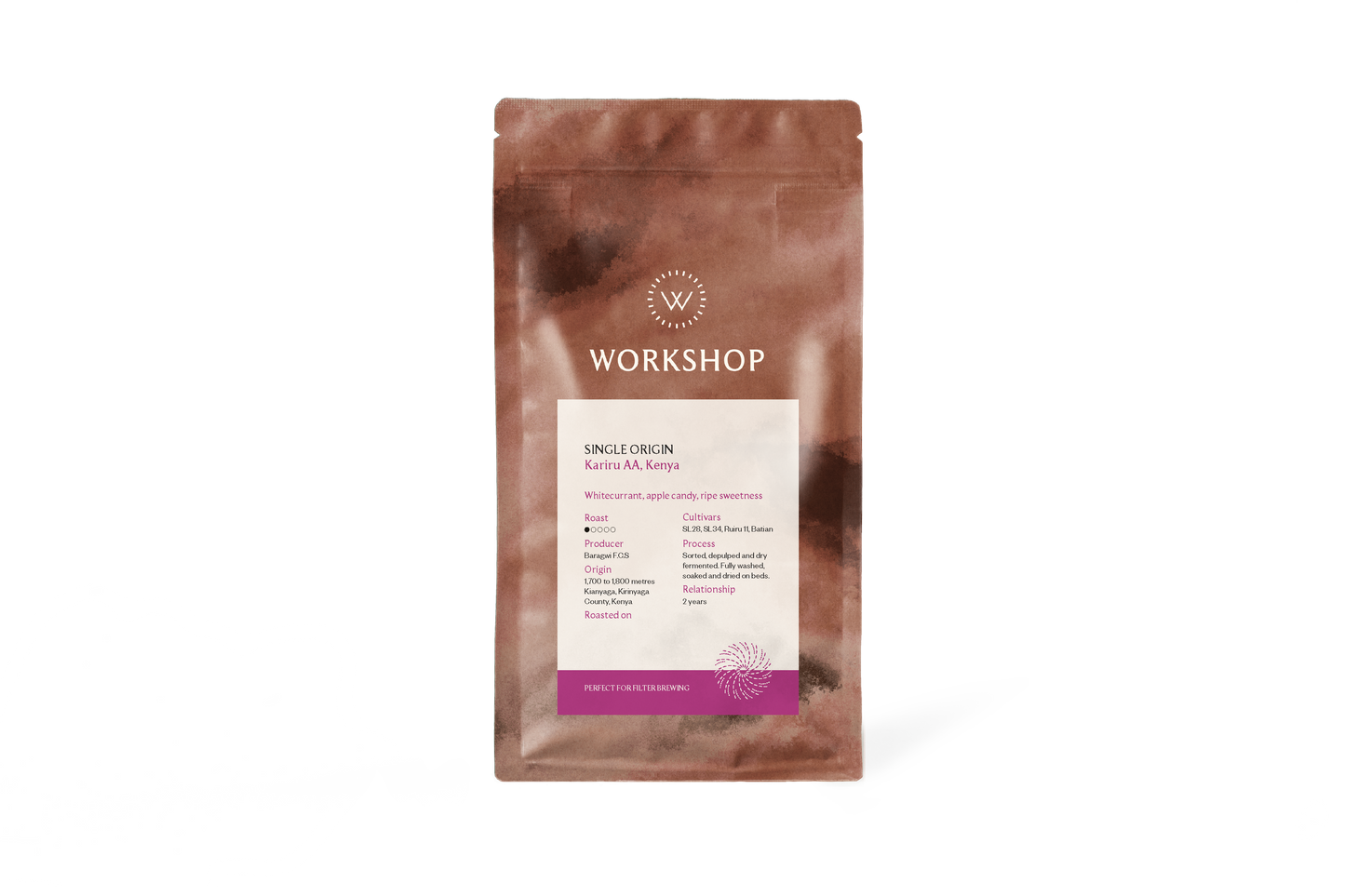
Around 2,500 coffee growers deliver their cherries to the Kariru factory for processing. With high altitudes of 1,700 to 1,800 metres and rich volcanic soils, the coffee has great potential to create the bright, juicy and fruity notes that we love so much in selections from Kenya.
The Process
Once harvested, the coffee cherries are sorted through by hand before undergoing processing. They are fed through a traditional disc pulper which refines the top grades and removes under-grades that are too hard to be squished by the pulper discs. The sticky, mucilage covered parchment coffee is first left to ferment in open air tanks, so that the native microbiome sets to work breaking down the pectin rich layer. Depending on the climate this can take between 18 and 36 hours. After the fermentation stage the tank is fed with clean water from Kamweti river, the coffee is washed, and it is then scrubbed and fed through channels to another tank where the coffee is soaked. This secondary washing or soaking stage aids homogenisation of the lots and can develop the flavours a little further, lending more structure, clarity and poise in the cup. The cleaned parchment is then slowly dried on raised beds in the sun before it is bagged up, milled and shipped to us in the UK.
The Farmers
Established in 1953, the Baragwi Farmers’ Co-operative Society oversees not just the operations at Kariru, but at 11 other factories, which are Muchagara, Thimu, Karumandi, Kagongo, Guama, Kianjiru, Kianyaga, Kyanja, Gachami, Githiururi and Rwambiti. They have 16,892 registered members supplying these 12 factories with coffee cherries as well as 137 staff employed to carry out logistics and run the washing stations.
As well as investing in producing high grade, specialty coffee the membership of the Baragwi F.C.S adhere to strong ethics which shape their methods of production. Amongst the 10 of their admirable guiding principles are a commitment to conserve the natural ecosystem, as well as aiding ecological restoration in critical areas and providing a refuge for native wildlife on their farms. They also focus on conservation of soil and water resources at the farm and factory level, using organic matter to enrich the soil as well as preventing erosion and minimising the use of chemical products through informed intercropping. Kariru for example is both Rainforest and 4C certified, with a mandate to repurpose washing water to pulp the next batch of coffee cherries to limit water usage.