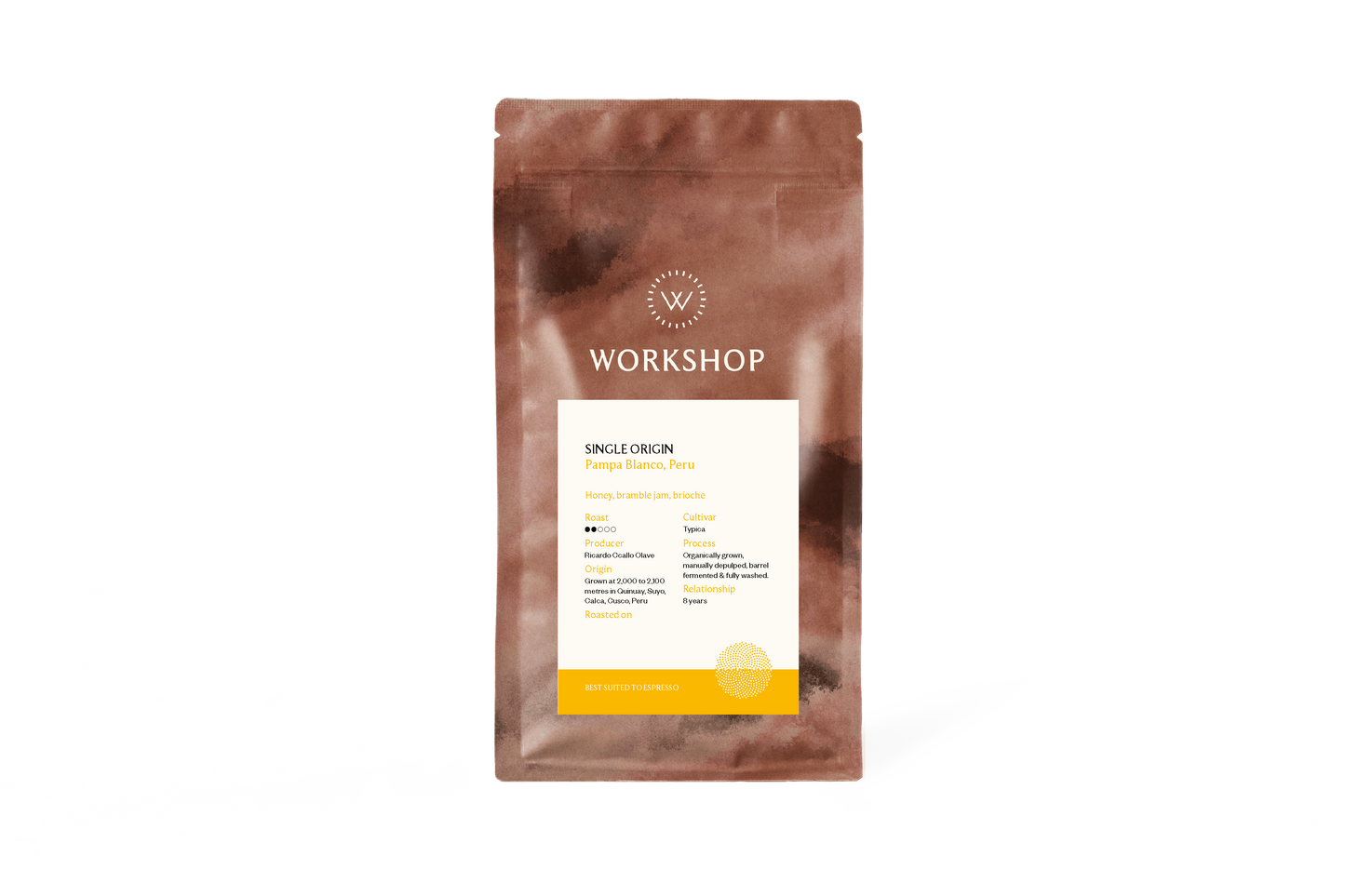
We’re pretty excited about this lot from Ricardo Ccallo Olave of Finca Pampa Blanco. High altitude Typica, grown organically, fermented in sealed barrels to produce a complex yet clean cup, and then washed and dried with care, it makes for a delectable espresso!
During our time visiting members of the Valle Inca Association we were able to connect first hand with Ricardo Ccallo Olave, of Finca Pampa Blanco, who is growing coffee in the Quinuay area of Peru’s Cusco region.
Farm & Origin
Finca Pampa Blanco in Quinuay experiences a breezy and dry climate. Ricardo grows almost exclusively Typica, with tiny amounts of Bourbon and Pache, on his 4-hectare farm which spans from 2,000 to 2,100 metres above sea level. He actively tries to keep moisture in the soil by leaving any fallen matter from shade trees, along with any spent Coca leaves, often chewed by workers whilst harvesting cherries, which grows in rows amongst the coffee. Not every part of the farm is suitable for coffee cultivation, and he actively chooses the best spots, as well as growing other shade trees and food crops, such as chirimoyas, oranges, avocado, limes and pacai.
The coffee trees are fed a rich compost, comprised mainly of chicken and guinea pig droppings, as well as spent coffee pulp, which worms break down into rich black humus. A good handful is added to each tree just before the rains come, which helps distribute the nourishing organic fertiliser, with any trees looking less vigorous receiving two handfuls of the nutrient-rich mulch. Having farmed coffee in this region for nearly 30 years, most of Ricardo's trees are between 25 and 30 years old. All of them get pruned right back every 6-8 years, but he pointed out some areas of his farm that will require a full replanting, where the coffee trees are simply too old and tired.
Harvest & Processing
Once harvested he initially floats the cherries to remove the less dense fruit. He then very gently manually de-pulps the coffee cherries, which is only achievable with a ripe harvest. With the sugars acting as a lubricant, it makes the job of turning the hand crank that little bit easier. Once sieved to remove any cherry skin the sugary parchment is put in GrainPro sacks and sealed in barrels to undergo what they call an "anaerobic fermentation". This system of processing by sealing the coffee into barrels with an airlock system that allows CO2 to escape is being described and marketed as an “anaerobic fermentation”. Whether or not a truly anaerobic environment is created, or if the term “anaerobic fermentation” is actually meaningful, are both debatable, but for us it is interesting to note that the group and their more willing coffee producers are taking steps to control more parameters that ultimately affect how the native microbiome of bacterias and yeasts go to work on their depulped coffee. Given how their lots cup every year we think they’re doing a great job of improving quality across the board using these controls and protocols.
Ricardo wakes around 3am to wash his coffee once the fermentation is complete, as he wants to get it out under the rising sun to maximise the hours of sunlight available. Dried on black mesh on patios and under a plastic roof with both sides open for ventilation, Ricardo wishes to eventually invest in raised beds to have more control over his drying.
Relationship & Partnership
We’re thrilled to have secured Ricardo’s coffee again this year, and hope to support him and the Valle Inca Association members for many years to come.
In 2018, our first year buying coffee through Valle Inca, the group had around 100 members. Thanks to word of mouth, with producers telling their neighbours of the premium prices that they were able to receive having been able to access a more discerning coffee market through the association, the group now works with over 375 producers in the Cusco region and have grown their operations to Puno and other producing areas. All the members are working organically and are certified as such via the Valle Inca group. For a member to join, there needs to be a baseline of quality met, dictated in part by altitude and the type of varieties planted, but ultimately it is down to the desire of each member to improve their quality through hard work. The group provides agronomical advice and training as well as pre-financing, so the farmer members are supported in multiple ways. Several of Valle Inca’s members repeatedly place well in Peru’s Cup of Excellence competition. We remain in touch with José Prudencio, the group’s president, throughout the year to hear how they are progressing and to maintain an open dialogue.